Malta company and director search
Search the companies and directors registered with the Malta Business Registry, and read how the register works: what companies must file, what anyone can see and what the law keeps private.
128,047 companies and 182,204 directors of Malta, from the records of the Malta Business Registry. Newest filing received: 18 November 2026.
Searching by name is free. Documents are paid one at a time; no subscription is necessary.
Malta company documents
Search the company, or open a document below and choose the company there. Each document page says what it contains and gives the price and the delivery time before you pay, with pages of a real example where we have one.
- Certificate of Good Standing with Apostille (Malta)
Official Malta certificate of good standing with apostille, delivered by courier as a physical document.
Printed document, sent by courier, up to 10 business days€300View details
Dato Capital is a private company, not the Malta Business Registry. A certificate or a copy is a document of the register that we obtain for you; a report is compiled by Dato Capital from the register's records.
Malta company information at a glance
Each company has a registration number in the register (company numbers).14 Any person may inspect the documents kept by the Registrar and obtain a certified copy, article 424 of the Companies Act.1 Since 1 August 2025 the registry's online company search requires a free login.29
- Public: the memorandum and articles, the registered office, the directors, company secretary and legal representatives, the members and their shares as filed, the annual accounts as filed (small companies and some parent companies may leave out some parts), and pledges of shares (what is public).1
- Not public: the beneficial owners, a restricted register open to anti-money laundering, tax and sanctions authorities, self-regulatory bodies and some European Union bodies, to obliged entities and, on a written request, to persons who show a legitimate interest in preventing money laundering or terrorist financing; the accounting records, open to the officers of the company; documents from investigations by the Registrar (beneficial owners, what is public).1, 3, 7
- Changes: a change among the directors or the secretary is reported within fourteen days, an allotment of shares within one month and a share transfer within fourteen days; each year the company files an annual return and its accounts (filings).1, 10
- Documents: the Registrar issues a certificate of registration, certified true copies of registered documents and a certificate regarding the directors; a Maltese public document can carry an apostille for use in another state party to the Hague Apostille Convention (documents and certificates).1, 11, 20, 28
- Status: a company has a legal personality of its own until its name is struck off the register. The name is struck off, among other cases, after a winding up, a simplified dissolution, a merger, or when the company is not carrying on business. The court can restore a name in the cases and time limits the act sets (company status).1
The Malta Business Registry
Companies and partnerships in Malta are registered by the Registrar of Companies, a senior official of the Malta Business Registry appointed by the Minister, article 400 of the Companies Act.1 The register is kept under the Companies Act (Chapter 386 of the Laws of Malta).1 The same registrar keeps the records of other legal persons listed in the Second Schedule of the Civil Code, article 401(1)(i).1
The register holds the documents a company must deliver: memorandum and articles, notices of change, annual returns and accounts, article 401(1)(d).1 Each document must be drawn up in one of the official languages of Malta, article 401(1)(d)(i).1 A certified translation into an official language of the European Union may be added, article 401(1)(d)(ii).1 If the translation and the document conflict, the translation cannot be relied on against third parties. Third parties can still rely on the translation, unless the company proves that they knew the version it had to deliver, article 401(1)(d)(ii).1
The register is kept current by short time limits: most changes must be reported within fourteen days, for example under articles 79(2), 120(3) and 146(1) (filings).1 The Registrar publishes a statement of each registration in the Gazette or on the registry website, normally within twenty-one days of receiving the complete documents, article 401(1)(e).1 A company can rely on a registered document against third parties only after that publication, unless it proves they knew of it, article 401(2).1
The search on this page covers 128,047 companies from the register of Malta. The newest filing held is dated 18 November 2026.
History
The Companies Act was passed as Act XXV of 1995 and came into force on 1 January 1996, in place of the Commercial Partnerships Ordinance.1 The registry was set up on 30 April 2018 as the Registry of Companies Agency and took over the registry work done until then within the Malta Financial Services Authority, articles 3, 10 and 11 of Legal Notice 144 of 2018.12 The amended order names it the Malta Business Registry, headed by the Registrar, articles 3 and 7.13
Types of company
The Companies Act knows three kinds of commercial partnership: the partnership en nom collectif, the partnership en commandite (limited partnership) and the company, article 4(1).1 A company is either a public company or a private company, article 4(3).1 Each commercial partnership has a legal personality of its own until its name is struck off the register, article 4(4).1
Private limited liability company (Ltd)
The memorandum is subscribed by at least two persons, or by the single member of a single-member company, article 68.1 In every Maltese Act the word "person" includes a body or other association of persons, unless the contrary intention appears, article 4(e) of the Interpretation Act.25 The capital of a company is divided into shares. A member is liable only for the amount still unpaid on their shares, article 67.1 The name of a private company ends with "private limited company", "limited" or "ltd.", article 70(2).1 Its memorandum or articles must restrict the transfer of shares, limit the members to fifty and forbid any invitation to the public to subscribe, article 209(1).1 The minimum authorised capital is EUR 1,164.69, and at least twenty per cent of each share taken up must be paid up when the memorandum is signed, article 72.1
A private company is an exempt company when its memorandum or articles add two conditions: no more than fifty debenture holders, and no body corporate as director and no outside control of its policy, article 211.1 An exempt company may have a single member if its objects name its main activity, article 212.1 Regulations of 2025 and 2026 add rules for agricultural companies, youth enterprises and sports private limited liability companies, all private companies.22, 23, 24
Public limited company (p.l.c.)
The name of a public company ends with "public limited company" or "p.l.c.", article 70(1).1 A European company (societas europaea) carries "SE" before or after its name instead, article 70(1).1 The minimum authorised capital is EUR 46,587.47, subscribed by at least two persons, with twenty-five per cent of each share paid up, article 72.1
Investment companies (SICAV and INVCO)
An investment company with variable share capital (article 84) carries "investment company with variable share capital" or "SICAV" in its name; a public investment company with fixed share capital may use "INVCO", article 70(3).1
Partnerships
In a partnership en nom collectif all partners are liable without limit, jointly and severally, article 7.1 In a partnership en commandite the general partners are liable without limit and the limited partners only for their unpaid contribution, article 51.1
Oversea companies and continued companies
A company formed abroad that sets up a branch or place of business in Malta must deliver its constitution, its directors and representatives and the branch details within one month, article 385.1 A foreign company can also move to Malta and continue as a Maltese company under the Continuation of Companies Regulations, regulation 3.15
Company numbers
Each company has a registration number in the register. For the European interconnection of business registers, its unique identifier is made of the letters MT and that number, regulation 7(2) of the System of Interconnection of Registers Regulations.14 A company of another member state with a branch in Malta also has a unique identifier, made of the letters MT, its registration number in Malta and elements that identify the member state of its home register, regulation 7.14 A company must show its name, kind, registered office and registration number on its business letters, order forms and website, article 6(1) of the Companies Act.1 The number heads forms such as Form K, Form R and the annual return in the Seventh Schedule.1, 10
When a company changes its name, the Registrar enters the new name on the register in place of the former name and issues an altered certificate of registration, article 80.1
What is public
The table describes the information normally obtainable from the Malta Business Registry or, where it says so, from the company. The legal basis gives the law, its article and its year; the year of a law does not show when an item first became public.
Scroll sideways to see all columns.
| Item | Public | Legal basis |
|---|---|---|
| Memorandum and articles of association | Yes | Companies Act 1995, articles 76, 4241 |
| Registered office and e-mail address in the memorandum | Yes | Companies Act 1995, article 69(1)(d); e-mail address added by Act XVIII of 20251, 16 |
| Directors, company secretary and legal representatives, with their residence | Yes | Companies Act 1995, articles 69(1)(g)–(h), 146, 424, Seventh Schedule1 |
| Members and their shares, as filed in the annual return and the share notices | Yes | Companies Act 1995, articles 103, 120, 184, 4241 |
| Register of members kept by the company | Open to the members, free of charge | Companies Act 1995, articles 123, 125(a)1 |
| Register of debentures kept by the company | Open to any person at the company, free of charge | Companies Act 1995, articles 124, 125(b)1 |
| Annual accounts and reports | Yes, as filed: a small company may leave out the directors' report, a small exempt company also the profit and loss account, and a parent company that prepares consolidated accounts may, on conditions, leave out its own profit and loss account (financial statements) | Companies Act 1995, articles 183, 185, 4241 |
| Accounts of an oversea company with a branch in Malta | Yes, as filed | Companies Act 1995, articles 387, 4241 |
| Pledges of shares and other securities | Yes | Companies Act 1995, articles 122, 4241 |
| Beneficial owners | Restricted access, not open to the general public: anti-money laundering, tax and sanctions authorities, self-regulatory bodies and some European Union bodies; obliged entities doing customer due diligence; and, on a written request, persons who show a legitimate interest in preventing money laundering or terrorist financing, to part of the data | Register of Beneficial Owners Regulations 2017, regulation 4, and regulation 7 as substituted by Legal Notice 184 of 20263, 7 |
| Accounting records | No public access; open to the officers of the company | Companies Act 1995, article 163(3)1 |
| Documents the Registrar obtains in an investigation | Excluded from public inspection | Companies Act 1995, articles 403–423, 424(a)1 |
Article 424 of the Companies Act is the rule of access. Any person may inspect the documents kept by the Registrar and obtain a copy of the certificate of registration or a copy or extract of any other document, certified as a true copy.1 Article 424 excludes the documents the Registrar obtains in an investigation under articles 403 to 423.1 The Fees Regulations set a fee for the inspection and download of documents, Schedule.11 Since 1 August 2025 the company search on the registry's online portal is open only to users who log in; registration is free.29
The register of beneficial owners is kept apart: documents delivered for it are not registered with the company file, regulation 4 of the Beneficial Owners Regulations.3
Directors
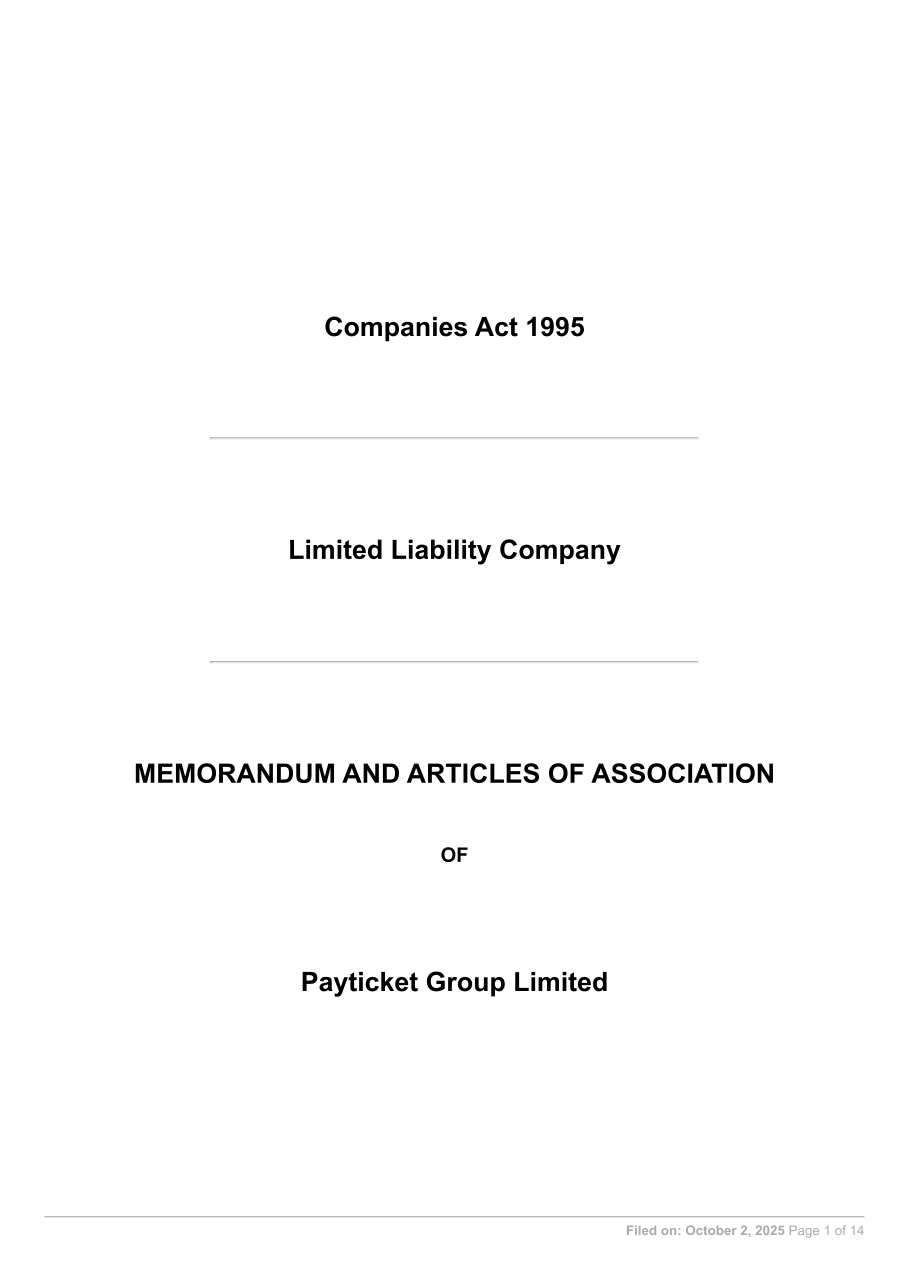
A public company has at least two directors and a private company at least one, article 137 of the Companies Act.1 The memorandum names the first directors with their residence, or the name and office of a body corporate director, and the persons who represent the company, article 69(1)(g).1 A body corporate can therefore be a director, except in an exempt company, article 211(2)(b).1 When the memorandum or articles require a director to hold a share qualification, the director vacates office if the qualification is not obtained within two months of appointment, or a shorter time fixed by the memorandum or articles, article 139(2).1
Every company also has a company secretary. A sole director cannot be the company secretary, and a body corporate can be secretary only if it is a registered company service provider, article 138.1 The sole director of an exempt company may also be its secretary, article 211(4).1
A person becomes a director only after signing the memorandum or delivering a written consent to the Registrar. On appointment the director declares whether any ground of disqualification applies, in Malta or in another member state, article 139.1 Interdicted or incapacitated persons, undischarged bankrupts, people convicted of money laundering, fraud or similar crimes, minors not emancipated for trade, people under a court disqualification order and people acting as a company service provider without the authorisation of the Malta Financial Services Authority cannot be a director or company secretary, article 142(1).1 A disqualification for a conviction lasts from three years to life, according to the punishment for the crime.1 The Registrar can also restrict a person from being appointed director or company secretary when, as a director or secretary of a Maltese company, that person breached the act three times within two years of the first breach and is still in default on one or more of them, article 142(4).1
The company must report any change among its directors, its secretary or the persons who represent it within fourteen days, with the name and residence of each new officer, article 146(1).1 The form is Form K of the Forms Regulations, which also carries the director's consent and declaration.10 The annual return repeats each director's name, nationality and usual residential address, Seventh Schedule.1 These filings are open to inspection under article 424.1
The general meeting can remove a director before the end of their term by a resolution of members holding more than half of the voting rights of the shares represented and entitled to vote at the meeting, whatever the memorandum or articles say, article 140(1) and (2).1
Beneficial owners
Malta has had a register of beneficial owners of companies since 1 January 2018, under the Companies Act (Register of Beneficial Owners) Regulations (Subsidiary Legislation 386.19).3 The Registrar keeps it, in electronic form only, regulation 4.3 The regulations do not apply to a company listed on a regulated market with disclosure requirements consistent with European Union law or equivalent international standards which ensure adequate transparency of ownership information, or to a company indirectly fully owned by such a listed company, regulation 2(3).3
What is filed
A new company files a declaration on all its beneficial owners with its memorandum. It gives each owner's name, date and place of birth, nationality, country of residence, residential address, identity document, any person holding shares as nominee and the nature and extent of the interest, with a certified copy of the identity document, regulation 3.3 The company also keeps its own register of beneficial owners at its registered office, regulation 5.3 A change of beneficial owners is notified within fourteen days after the company records it, regulation 6(1). With a notice of a share transfer or transmission, or of a change in the issued share capital or voting rights, the company also files a beneficial-owner notice saying whether the beneficial owners changed; without it the Registrar does not register the transfer, transmission or allotment, regulation 6(2) and (3).3 Each year the company also confirms or updates the information within forty-two days of the anniversary of its registration, regulation 6A.3
Since 10 July 2026 a simpler rule applies to some companies. It applies while all registered shareholders are individuals, none of them holds shares as a trustee or in another fiduciary capacity, no individual other than the members owns or controls more than twenty-five per cent of the voting rights or other ownership interests or controls the company by other means, and no individual holds the position of senior managing official, regulation 5(3). A senior managing official is recorded as a beneficial owner when, after all possible means, no individual who owns or controls the company has been identified, First Schedule. While the rule applies, the register of members counts as the register of beneficial owners. The company does not file the notice of a change of beneficial owners, or the beneficial-owner notice that otherwise goes with a share transfer or a change in share capital or voting rights, regulation 6(1) and (2). It does not file the yearly beneficial-owner return either, regulation 6A(1).7 Companies registered before 10 July 2026 have six months from that date, until 10 January 2027, to check whether the rule applies to them.8
Who can see it today
Since 10 July 2026 (Legal Notice 184 of 2026), regulation 7 gives three levels of access.3, 7
- Anti-money laundering, tax and sanctions authorities, self-regulatory bodies and some European Union bodies: immediate, direct and free access, without alerting the company, regulation 7(1)(a).
- Obliged entities under the European anti-money laundering rules, for customer due diligence: access against a fee, regulation 7(1)(b).
- Any person with a legitimate interest in preventing money laundering, its predicate offences or terrorist financing: the name, month and year of birth, country of residence, nationality and the nature and extent of the interest, against a fee, regulation 7(1)(c).
Journalists and civil society organisations working against money laundering, persons likely to enter into a transaction with the company who intend to prevent any link between the transaction and money laundering, and some public authorities, such as the authorities of member states that register companies, are deemed to have a legitimate interest, regulation 7(1)(c).3 The request is made in writing. The Registrar answers within twelve working days, a time that can be extended when requests suddenly rise, and grants access by a certificate valid for three years, regulation 7B.3 A refusal can be appealed to the Administrative Review Tribunal within twenty days, regulation 7D(3).3 The decision of the Tribunal can be appealed to the Court of Appeal (Inferior Jurisdiction) within twenty days, regulation 7D(4).3 The Registrar can withhold an owner's details when access would expose the owner to a disproportionate risk such as fraud, kidnapping or violence, or when the owner is a minor, regulation 7F.3 The Registrar keeps a record of the persons who access the register under regulation 7(1)(c) and can disclose it to a beneficial owner who asks for it under article 15(1)(c) of the General Data Protection Regulation, regulation 7A(1).3 When the persons who consulted the register are journalists or civil society organisations whose work is connected with preventing or combating money laundering, its predicate offences or terrorist financing, only their occupation or function is disclosed, regulation 7A(1).3
How access changed
- 1 April 2018: authorities, subject persons doing customer due diligence, and persons who showed a legitimate interest, the last two for EUR 5 a search, regulations 1(3) and 7 of Legal Notice 374 of 2017.4
- 1 January 2020: any member of the general public could see the name, month and year of birth, nationality, country of residence and the extent and nature of the interest of each owner, Legal Notice 158 of 2019.5
- 22 November 2022: the Court of Justice of the European Union declared invalid the European rule that gave the general public access in all cases, Joined Cases C-37/20 and C-601/20.9
- 25 November 2022: the Malta Business Registry limited access to competent authorities and subject persons.21
- 10 July 2025: the law replaced public access by access for persons with a legitimate interest, Legal Notice 127 of 2025.6
- 10 July 2026: the present three-level system, request procedure and access certificates, Legal Notice 184 of 2026.7
Financial statements
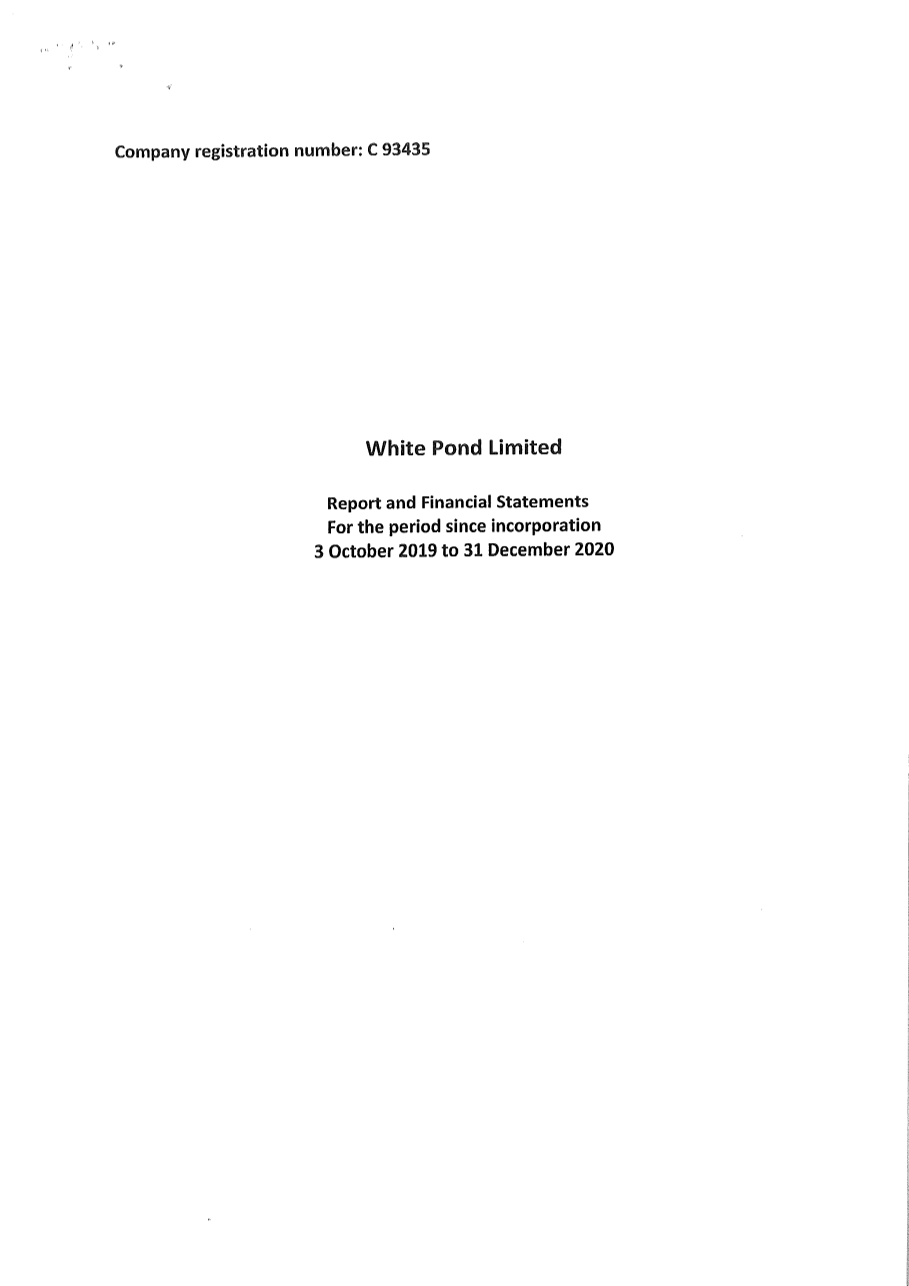
Every company keeps proper accounting records at its registered office or another place the directors choose, open to its officers, article 163 of the Companies Act.1 Its accounting reference date is 31 December unless it notifies another date within nine months of registration, article 164 (Form R).1, 10
For each accounting period the directors prepare individual accounts: a balance sheet, a profit and loss account and notes, which must give a true and fair view, article 167.1 The accounts are laid before the general meeting within ten months after the end of the period for a private company and seven months for a public company, article 182(2).1 The directors then deliver the accounts, the auditors' report and the directors' report to the Registrar within forty-two days after that period, article 183(1).1 For a private company with a year ending on 31 December, the last day is therefore in December of the following year, articles 182(2) and 183(1).1 Accounts in a language other than Maltese or English are filed with a certified translation into Maltese or English, article 183(5).1
Exemptions by size
A small company stays within at least two of three limits: a balance sheet total of EUR 5,000,000, a net turnover of EUR 10,000,000 and fifty employees, article 185(1). These limits apply since 20 March 2026.1, 17 A small company need not file its directors' report. A small exempt company need not file its directors' report or its profit and loss account, article 183(2).1 The directors file a declaration on the prescribed form that the company qualifies, article 183(3).1
A private company that stays within two of these limits is exempt from the rules on auditors and the audit report: a balance sheet total of EUR 46,600, a net turnover of EUR 93,000 and two employees, article 185(2).1 Such a company has no audit and files no auditors' report, articles 183(2) and 185(2).1 All other companies appoint an auditor at each general meeting where accounts are laid, article 151.1 A change of size counts only when it lasts two consecutive periods, article 185(3).1
A parent company that prepares consolidated accounts may, on conditions, file its annual accounts without its own profit and loss account, article 183(4).1 An oversea company with a branch in Malta files a balance sheet, a profit and loss account and notes within twelve months after the end of each accounting period, article 387.1 The accounts filed with the Registrar are public under article 424.1 Any member and any debenture holder can also obtain from the company, on demand and free of charge, a copy of the last annual accounts laid before the general meeting, article 180(5).1
Filings
The forms are set out in the Companies Act (Forms) Regulations (Subsidiary Legislation 386.01), last amended by Legal Notice 287 of 2025.10 Late filing makes each officer in default liable to an administrative penalty and a daily penalty, within the maximum amounts of the Eleventh Schedule, article 427.1 Accounts and annual returns can be delivered by electronic means, authenticated by an electronic signature that the Registrar recognises, articles 82, 183(1) and 184(2).1
Scroll sideways to see all columns.
| Filing | What it reports | Time limit | Law |
|---|---|---|---|
| Memorandum and articles, with the beneficial-owner declaration | Formation of the company | Before registration | Companies Act 76; BO Regulations 3 |
| Form K | Change among directors, company secretary or representatives, with consent | 14 days | Companies Act 139, 146 |
| Resolution and updated memorandum | Change to the memorandum or articles, including the name | 14 days | Companies Act 79(2) |
| Form Q | Change of registered office or e-mail address | 14 days | Companies Act 79(2) |
| Form H | Allotment of shares | One month | Companies Act 103 |
| Form T | Transfer or transmission of shares | 14 days; one month on death | Companies Act 120(3) |
| Forms T(2) and T(3) | Pledge of securities and its end | 14 days | Companies Act 122 |
| Forms I and I(1) | Becoming or ceasing to be a single-member company | 14 days | Companies Act 212 |
| Form R | Accounting reference date | Nine months from registration | Companies Act 164 |
| Annual accounts and reports | Balance sheet, profit and loss, notes, reports | 42 days after the laying period | Companies Act 182, 183 |
| Accounts of an oversea company | Balance sheet, profit and loss, notes | Twelve months after each accounting period | Companies Act 387 |
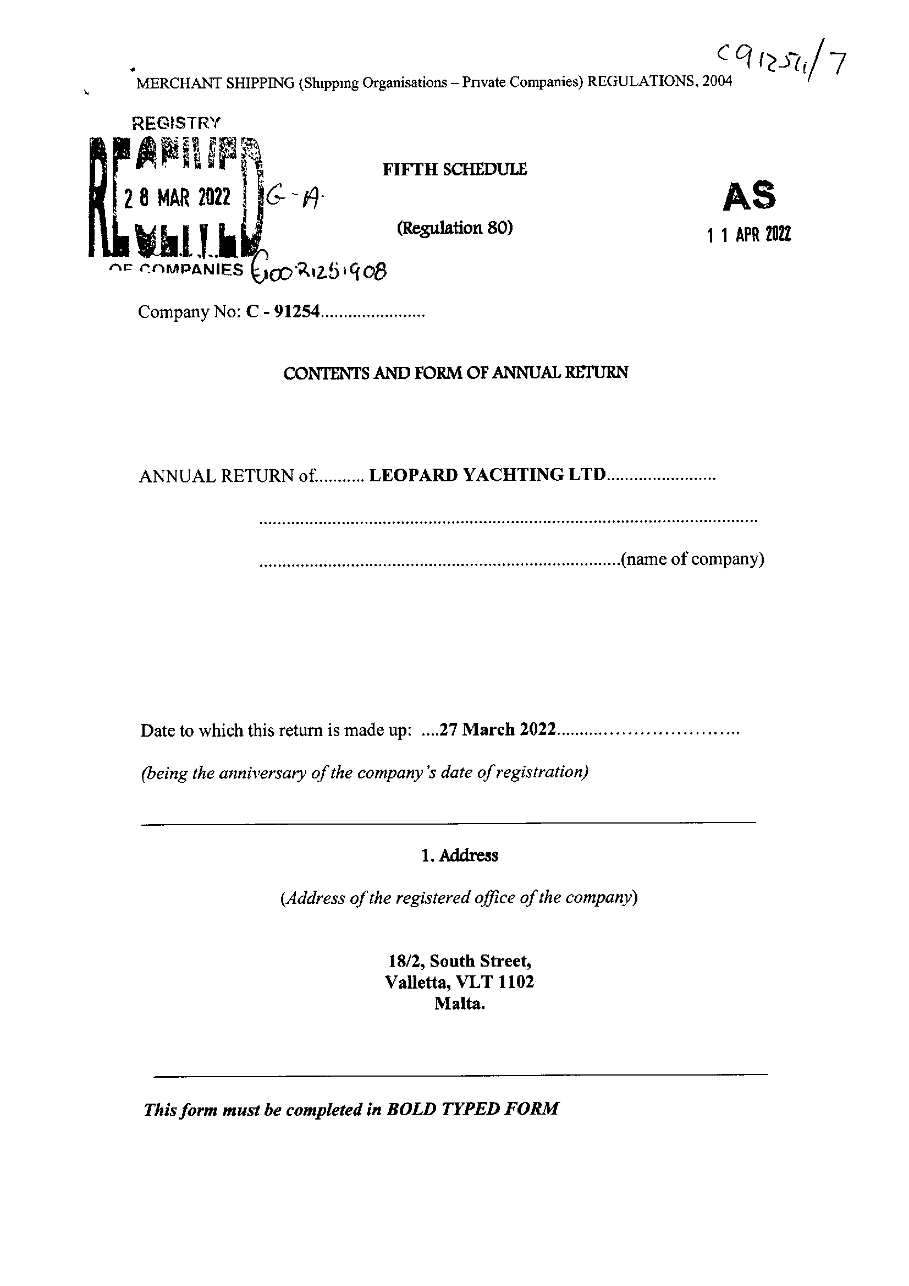
| Annual return | Office, capital, members, directors, secretary | 42 days after each anniversary | Companies Act 184 |
| Beneficial-owner notice | Change of beneficial owners | 14 days | BO Regulations 6 |
| Beneficial-owner return | Yearly confirmation of beneficial owners | 42 days after each anniversary | BO Regulations 6A |
| Notice of resolution and Form B(2) | Voluntary winding up and declaration of solvency | 14 days | Companies Act 265, 268 |
| Form L | Appointment of a liquidator | 14 days | Companies Act 290 |
| Form L(4) | Winding up not finished after twelve months | 30 days, then every six months | Companies Act 322 |
| Forms B1, B(3) and B(4) | Simplified dissolution | On application | Companies Act 214A |
| Form M | Branch of an oversea company | One month | Companies Act 385 |
Sources for the table: the Companies Act,1 the Beneficial Owners Regulations3 and the Forms Regulations.10
Documents and certificates
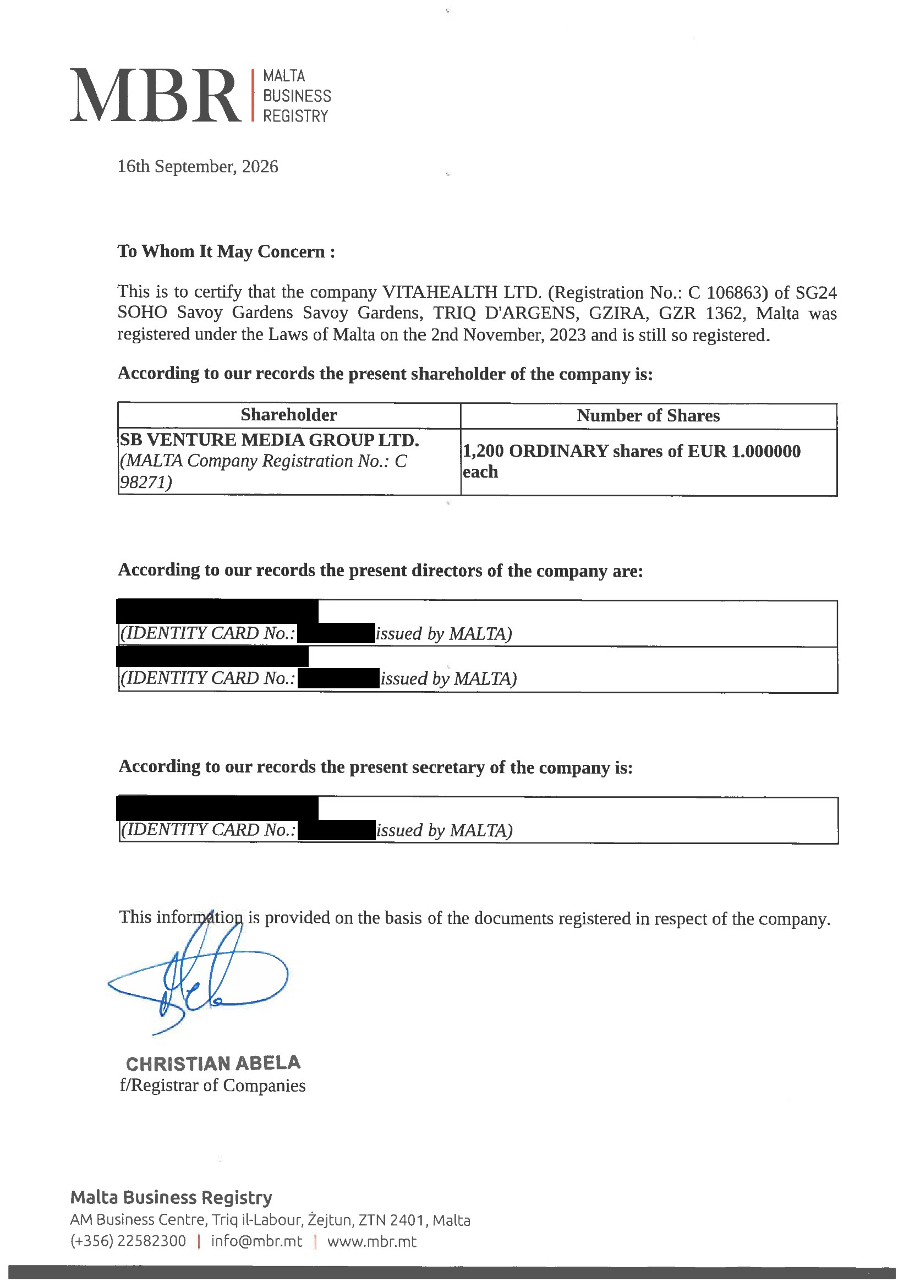
When it registers a company, the Registrar issues a certificate of registration. It shows the date from which the company exists and is conclusive evidence that the company is duly registered as a public or private company, article 77 of the Companies Act.1 A change of name or of status gives an altered certificate, articles 80 and 213(3).1
Any person can obtain a copy of the certificate of registration and a copy or extract of any registered document, and have it certified by the Registrar as a true copy, article 424(b).1 Copies can be supplied by electronic means, article 401(1)(f).1 The Fees Regulations list certified true copies, a certificate regarding the directors of a company and any other certificate regarding a company issued on request.11
Malta is a party to the Hague Apostille Convention, in force for Malta since 3 March 1968.20 A Maltese public document covered by the Convention can therefore carry an apostille for use in another state party to the Convention, article 1.28 The apostille certifies the authenticity of the signature, the capacity in which the person signing the document has acted and, where appropriate, the identity of the seal or stamp which the document bears, articles 3 and 5.28 It does not authenticate the content of the document.30
Charges and mortgages
The Companies Act has no general register of charges over a company's assets. It provides for the registration of pledges of shares and other securities. Notice of a pledge goes to the Registrar within fourteen days, and the pledge has effect against third parties only after registration, article 122(2) and (3).1 The securities of a private company can be pledged only if its memorandum or articles specifically provide for it, article 122(1).1 The company records the pledge in its register of holders of the securities, article 122(2).1 Debentures are entered in the company's register of debentures, which any person can inspect free of charge, articles 124 and 125(b).1
Other security is registered elsewhere. A hypothec is effective only when it is registered in the Public Registry, article 2033 of the Civil Code.26 A mortgage of a registered Maltese ship is recorded in the register of ships, articles 38 and 39 of the Merchant Shipping Act.27 A search of the company register may therefore not show all charges over a company's assets.
Company status
Dissolution and winding up
A company is dissolved by an extraordinary resolution to be wound up by the court or voluntarily, article 214(1) of the Companies Act.1 The court may dissolve it when its business has been suspended for twenty-four months or when it cannot pay its debts. It must dissolve it when it has fewer than two members (except a single-member company under article 212), or fewer directors than the minimum, for more than six months, article 214(2).1
Notice of a resolution for voluntary winding up reaches the Registrar within fourteen days, article 265.1 In a voluntary winding up the directors can make a declaration of solvency: that the company will pay its debts in full within twelve months, article 268.1 The liquidator reports the appointment within fourteen days, article 290.1 If the winding up is not concluded within twelve months of the dissolution, a liquidator other than the official receiver sends the Registrar a statement within thirty days and then every six months, article 322.1 When the final accounts are registered, the Registrar strikes the name off three months after publishing the notice, articles 275 and 285.1 The liquidator keeps the company's accounts, accounting records and documents for ten years from the publication of the striking off, article 324(2).1
Simplified dissolution
Since 16 December 2025 a private company registered for at least six months can apply to be struck off without a liquidation, article 214A.1, 16 It must not have traded, employed staff, changed its name or pledged its shares in the six months before. It must have no documents or penalties outstanding with the Registrar. Its directors declare that its debts are paid or written off and that its assets are no more than EUR 5,000. The name is struck off three months after the notice.1 Entities regulated by any law in Malta and public limited companies cannot use this route, article 214A(1).1
Defunct companies and restoration
When the Registrar believes a company is not carrying on business, the Registrar writes to it. If the company confirms this, or does not answer within one month, the Registrar publishes a notice, and three months later the name is struck off and the company's assets pass to the Government of Malta, article 325(1) and (2).1 When a voluntary winding up seems finished or no liquidator is acting, and the liquidator's returns are six months or more overdue, the Registrar can publish a notice; three months later the winding up is deemed concluded and the name is struck off, article 325(3).1 A member, a creditor or another interested person can ask the court to restore a name struck off under article 325 within five years of the notice of striking off, article 325(4).1 Where the name was struck off after a winding up, the court can also restore it and reopen the winding up when the winding up and striking off were vitiated by fraud or material illegality and this is the only remedy available, on an application made within five years of the striking off, article 300B.1 After a simplified dissolution, any interested person can ask the court to restore the name, article 214A(7).1 The liability of directors, officers and members continues after the name is struck off, article 325(6).1
When a merger by acquisition takes effect, the Registrar strikes off the names of the companies acquired, article 353.1
Company recovery
A company that is unable, or imminently likely to become unable, to pay its debts can be placed by the court under the company recovery procedure, run by a special controller appointed by the court, article 329B.1
Legislation
Laws in force
Scroll sideways to see all columns.
| Law | Year | What it governs |
|---|---|---|
| Companies Act (Chapter 386) | 1995, in force 1 January 1996 | Companies and partnerships, the register, accounts, winding up |
| Companies Act (Forms) Regulations (S.L. 386.01) | 1996 | The statutory forms |
| Companies Act (Fees) Regulations (S.L. 386.03) | 2008 | Registry fees for filing, copies and certificates |
| Continuation of Companies Regulations (S.L. 386.05) | 2002 | Foreign companies moving to Malta and back |
| System of Interconnection of Registers Regulations (S.L. 386.18) | 2017 | Link with the registers of other member states |
| Register of Beneficial Owners Regulations (S.L. 386.19) | 2017, in force 1 January 2018 | Beneficial owners of companies |
| Malta Business Registry (Establishment as an Agency) Order (S.L. 595.27) | 2018 | The registry agency |
Sources: the Companies Act,1 the regulations3, 10, 11, 14, 15 and the agency order.13
If the English and Maltese texts of the Companies Act, or of a regulation made under it, conflict, the English text prevails, article 2(7) of the Companies Act.1
Timeline
- 19 April 1965: the Commercial Partnerships Ordinance (Ordinance X of 1962) comes into force.2
- 1 January 1996: the Companies Act (Act XXV of 1995) replaces the Ordinance. Companies formed under the Ordinance are governed by the act in full from 1 March 1998, article 428.1
- 21 March 2017: Act XI of 2017 ends bearer share warrants.18
- 1 January 2018: the register of beneficial owners starts.4
- 30 April 2018: the registry becomes an agency, separate from the Malta Financial Services Authority.12
- 1 January 2020: beneficial-owner data opens to the general public.5
- 22 and 25 November 2022: the Court of Justice ruling and the end of public access.9, 21
- 17 May 2024: Act XVIII of 2024 adds public reports of income tax information by large groups, for periods from 22 June 2024, articles 213B to 213D.19
- 10 July 2025: beneficial-owner access for persons with a legitimate interest.6
- 7 August 2025, 16 December 2025 and 28 April 2026: Act XVIII of 2025 comes into force in parts, adding the company e-mail address and the simplified dissolution.16
- 20 March 2026: the present limits for small companies, Act I of 2026.17
- 10 July 2026: the present beneficial-owner rules, Legal Notice 184 of 2026, completed by Legal Notice 226 of 2026.7, 8
Questions
Who keeps the company register in Malta?
The Registrar of Companies keeps it. The Registrar heads the Malta Business Registry, a government agency since 2018, article 400 of the Companies Act and article 7 of the agency order.
Is the Malta company register public?
Yes. Under article 424 of the Maltese Companies Act any person may inspect the documents kept by the Malta Business Registry and obtain certified copies. Since 1 August 2025 the registry's online company search requires a free login. The register of beneficial owners is separate: it is not open to the general public, only to anti-money laundering, tax and sanctions authorities, self-regulatory bodies and some European Union bodies, obliged entities and persons who show a legitimate interest in preventing money laundering or terrorist financing.
Can I find the directors of a Maltese company?
Yes. A Maltese company reports every change among its directors and company secretary to the Malta Business Registry within fourteen days, article 146 of the Companies Act. Its annual return lists each director's name, nationality and usual residential address. These filings are open to inspection, article 424.
Can I find the shareholders of a Maltese company?
Yes, as filed. The annual return of a Maltese company lists every shareholder and every transfer since the last return, and share transfers are notified to the Malta Business Registry within fourteen days. The register of members kept at the company is open to its members, article 125(a) of the Companies Act.
Can the public see the beneficial owners of a Maltese company?
Access is restricted. Under regulation 7 of the Maltese Register of Beneficial Owners Regulations, as substituted on 10 July 2026, a person who shows a legitimate interest in preventing money laundering, its predicate offences or terrorist financing can ask the Malta Business Registry in writing for the owners' names, month and year of birth, country of residence, nationality and the nature and extent of their interest, against a fee. Authorities and obliged entities doing due diligence have their own access. The general public has had no access since 25 November 2022.
Are the accounts of Maltese companies public?
Yes, as filed. Every company registered under the Maltese Companies Act files its annual accounts with the Malta Business Registry, and anyone can inspect them, articles 183 and 424. Small companies may leave out the directors' report, small exempt private companies also the profit and loss account, and a parent company preparing consolidated accounts may, on conditions, leave out its own profit and loss account, article 183. An oversea company with a branch in Malta files accounts within twelve months of the end of each accounting period, article 387.
When must a Maltese company file its accounts?
A private company in Malta files within ten months and forty-two days after the end of its financial year; a public company within seven months and forty-two days. The accounts go to the Malta Business Registry, articles 182 and 183 of the Companies Act.
What is the minimum share capital of a Maltese company?
EUR 1,164.69 for a private limited company, with twenty per cent paid up, and EUR 46,587.47 for a public limited company, with twenty-five per cent paid up, article 72 of the Maltese Companies Act. The memorandum filed with the Malta Business Registry states it.
What does "Ltd" or "p.l.c." mean after a Maltese company name?
"Ltd" or "limited" marks a private limited liability company and "p.l.c." a public limited company, article 70 of the Maltese Companies Act. "SICAV" marks an investment company with variable share capital. All are registered with the Malta Business Registry.
Can a struck-off Maltese company be restored?
In some cases. When the Malta Business Registry struck off the name under article 325 of the Companies Act (a company not carrying on business, or a voluntary winding up the Registrar treats as concluded), a member, creditor or other interested person can ask the court in Malta to restore it within five years of the striking-off notice. After a winding up completed by the liquidator, the court can restore the name when the winding up and striking off were vitiated by fraud or material illegality and this is the only remedy available, on an application made within five years of the striking off, article 300B; after a simplified dissolution, any interested person can apply, article 214A(7).
Are there bearer shares in Malta?
Since Act XI of 2017 no Maltese company may issue share warrants to bearer, and warrants not surrendered within nine months of that act coming into force are deemed cancelled, articles 121 and 121A of the Companies Act. Shareholders appear in the filings at the Malta Business Registry.
Sources
- Companies Act (Chapter 386 of the Laws of Malta), consolidated to Act I of 2026, articles 2, 4–7, 51, 67–84, 103, 120–125, 128, 137–146, 151, 163–185, 209–214A, 265–290, 300B, 322–329B, 353, 385–387, 400–401, 424–428, Seventh and Eleventh Schedules. Read on 27 November 2026.
- Commercial Partnerships Ordinance (Chapter 168, Ordinance X of 1962), title page. Read on 16 November 2026.
- Companies Act (Register of Beneficial Owners) Regulations (S.L. 386.19), consolidated to Legal Notice 226 of 2026, regulations 2–7F, 17. Read on 27 November 2026.
- Legal Notice 374 of 2017, Companies Act (Register of Beneficial Owners) Regulations, 2017, regulations 1(3) and 7. Read on 27 November 2026.
- Legal Notice 158 of 2019, Register of Beneficial Owners (Amendment) Regulations, 2019, regulation 3. Read on 27 November 2026.
- Legal Notice 127 of 2025, Register of Beneficial Owners (Amendment) Regulations, 2025, regulations 1 and 6. Read on 16 November 2026.
- Legal Notice 184 of 2026, Register of Beneficial Owners (Amendment) Regulations, 2026, Government Gazette of 10 July 2026. Read on 27 November 2026.
- Legal Notice 226 of 2026, Register of Beneficial Owners (Amendment No. 2) Regulations, 2026, regulation 2. Read on 16 November 2026.
- Court of Justice of the European Union (Grand Chamber), judgment of 22 November 2022, Joined Cases C-37/20 and C-601/20, operative part. Read on 16 November 2026.
- Companies Act (Forms) Regulations (S.L. 386.01), consolidated to Legal Notice 287 of 2025, Schedule. Read on 27 November 2026.
- Companies Act (Fees) Regulations (S.L. 386.03), Schedule. Read on 27 November 2026.
- Legal Notice 144 of 2018, Registry of Companies (Establishment as an Agency) Order, articles 3, 10, 11. Read on 16 November 2026.
- Malta Business Registry (Establishment as an Agency) Order (S.L. 595.27), articles 3, 7, 9A. Read on 16 November 2026.
- Companies Act (System of Interconnection of Registers) Regulations (S.L. 386.18), regulation 7. Read on 27 November 2026.
- Continuation of Companies Regulations (S.L. 386.05), regulations 3–4. Read on 16 November 2026.
- Act XVIII of 2025, Companies (Amendment) Act, 2025, with the commencement notices Legal Notices 174 of 2025, 286 of 2025 and 110 of 2026. Read on 27 November 2026.
- Act I of 2026, Various Laws relating to Corporate Sustainability Reporting (Amendment) Act, 2026, article 26, with the commencement notice Legal Notice 61 of 2026 (20 March 2026). Read on 16 November 2026.
- Act XI of 2017, Companies (Amendment) Act, 2017, articles 6–7. Read on 16 November 2026.
- Act XVIII of 2024, Companies (Amendment) Act, 2024, articles 1 and 14. Read on 27 November 2026.
- Hague Convention of 5 October 1961 Abolishing the Requirement of Legalisation for Foreign Public Documents, status table, entry for Malta. Read on 18 November 2026.
- Malta Business Registry, Notice to the general public – Provision requiring public access to BO information declared invalid by the Court of Justice of the European Union, 25 November 2022. Read on 18 November 2026.
- Companies Act (Agricultural Companies) Regulations (S.L. 386.30, Legal Notice 307 of 2025), regulations 1–2. Read on 16 November 2026.
- Companies Act (Youth Enterprise) Regulations (S.L. 386.32, Legal Notice 56 of 2026), regulation 2. Read on 16 November 2026.
- Sports Private Limited Liability Companies Regulations (S.L. 386.33, Legal Notice 91 of 2026), regulations 1–2. Read on 27 November 2026.
- Interpretation Act (Chapter 249 of the Laws of Malta), article 4(e). Read on 16 November 2026.
- Civil Code (Chapter 16 of the Laws of Malta), article 2033. Read on 16 November 2026.
- Merchant Shipping Act (Chapter 234 of the Laws of Malta), articles 38–39. Read on 16 November 2026.
- Hague Convention of 5 October 1961 Abolishing the Requirement of Legalisation for Foreign Public Documents, full text, articles 1, 3 and 5. Read on 18 November 2026.
- Malta Business Registry, Public Notice – Update to access to basic information on the BAROS, 1 August 2025. Read on 18 November 2026.
- Hague Conference on Private International Law, Outline of the HCCH 1961 Apostille Convention, "The effect of an Apostille". Read on 18 November 2026.
New in the register
This guide was reviewed on 27 November 2026 against the laws in its sources list. It is general information and not legal advice. Dato Capital is a private company; it is not the Malta Business Registry and does not act for it.